What Happened to Zebit
Zebit was one of the only BNPL marketplaces built specifically for US shoppers with limited credit. The service launched in 2015, listed on the Australian Securities Exchange in 2020, delisted in 2022, and has not relaunched. Here is the full Zebit shutdown timeline, what triggered the wind-down, and what former customers should do next.
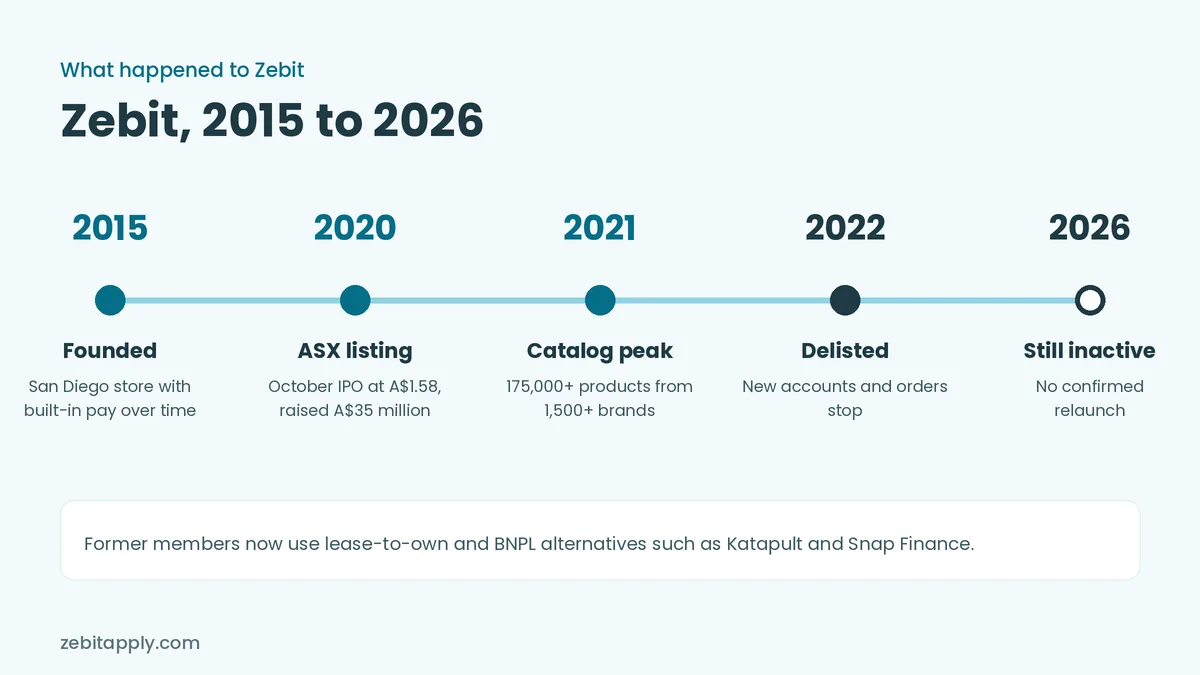
Zebit timeline: 2015 to 2026
Marc Schneider co-founds Zebit with a focus on the 120 million Americans who live paycheck to paycheck and cannot access a traditional credit card. The pitch is BNPL for people the mainstream financial system has excluded.
The company grows the Zebit Market by signing 81 drop-ship partners and reaching tens of thousands of credit-challenged shoppers. The company builds proprietary machine-learning underwriting models trained on five years of shopper data.
The company lists on the Australian Securities Exchange under ticker ZBT. The IPO raises A$35 million after it cuts the planned price from A$2.00 to A$1.58. Shares close day one at A$1.04, down 34 percent. Investor appetite for BNPL stocks had cooled.
Zebit Market reaches more than 175,000 SKUs across 1,500 brands. Shopper spending limits scale from $750 up to $2,500 for the strongest profiles. BNPL competition from Affirm, Afterpay, and Klarna intensifies at the same time.
The company delists from the ASX. Order volume contracts sharply through the year. New account approvals slow, the catalog thins, and customer-service response times extend. The company does not issue a public shutdown statement.
Through 2023, 2024, 2025, and into 2026, the marketplace stays offline. Occasional login windows appear for existing account holders. No new accounts, no new orders, and no confirmed relaunch date.
Why Zebit shut down: the underlying pressures
No single catalyst took Zebit down. Several pressures compounded through 2021 and 2022 that made the model unsustainable at the scale the company needed to service its public shareholders.
BNPL went mainstream, Zebit's niche shrank
When it launched, there was no mass-market BNPL option for subprime shoppers. By 2022, Affirm, Afterpay, Klarna, PayPal Pay in 4, and Zip were all offering split payments at major retailers. Even shoppers with limited credit could often find a BNPL path at Walmart, Target, Best Buy, or Amazon. The company no longer had a defensible monopoly on no-credit-check shopping credit.
Marketplace unit economics got harder
The revenue model relied on marking up marketplace prices high enough to fund the six-month interest-free plan. As mainstream retailers aggressively discounted and as inflation squeezed shopper discretionary budgets, those markups became more visible. Trustpilot and other review platforms carried a steady stream of complaints that marketplace prices ran well above typical retail. Price-conscious shoppers increasingly compared those prices against the open internet and left.
Underwriting a credit-challenged book is expensive
Default risk on subprime BNPL is structurally higher than on prime BNPL. Zebit's underwriting improved over time, but a thin-margin retail business funding its own BNPL book is harder to scale profitably than the prospectus had modeled. The 2020 IPO raised A$35 million against a projected multi-year path to profitability. The macro environment did not cooperate.
Regulatory scrutiny on subprime BNPL increased
Through 2021 and 2022, the US Consumer Financial Protection Bureau opened inquiries into major BNPL providers. For a smaller BNPL marketplace with subprime concentration, the cost of regulatory compliance started to look large relative to total revenue.
What former Zebit customers should do now
If you have an open Zebit balance
Your original Zebit repayment agreement remains binding unless you receive direct, written notice that the balance has been discharged. Keep records of your payments and any communications from the company. If you suspect fraud or incorrect reporting, you can file a complaint with the Consumer Financial Protection Bureau at consumerfinance.gov.
If you need the same kind of shopping credit
The closest working equivalents to Zebit today are lease-to-own providers: Katapult, Snap Finance, Progressive Leasing, and Aaron's. All four approve shoppers who would not meet a typical 620 FICO cutoff, using their own data instead of relying on a credit score alone. For broader BNPL at mainstream retailers, Affirm lets you prequalify with a soft credit check. See our Zebit alternatives page for the full side-by-side comparison.
If you want to confirm the status directly
The zebit.com domain is still registered but the storefront is inactive. There is no official customer service number currently answering new-account calls. Any outreach claiming to represent Zebit and asking for payment on an account you do not recognize should be verified against your original account records before you act on it.
Will Zebit come back?
There is no confirmed Zebit relaunch. A return would require significant restructuring, fresh capital, and a credible plan for competing in a BNPL market that has consolidated around Affirm, Klarna, Afterpay, and PayPal. We will update this page if that changes. In the meantime, treat it as a historical case study, not a current option.