How Zebit Worked
Zebit built a unique BNPL marketplace model that combined e-commerce and installment financing under one roof. This page walks through how Zebit worked in practice: how you applied, how the spending limit was assigned, how the payment plan was structured, and what the Zebit Market actually sold.
Step 1: Account creation and underwriting
To get started, a shopper first created an account at zebit.com. Registration asked for name, address, Social Security number, income, and employment information. The company used that data to run a soft-pull identity check through specialty credit bureaus. There was no hard credit pull and no impact to FICO scores.
Underwriting had two layers. The first layer evaluated the application and assigned a conditional spending limit. The second layer re-evaluated every purchase attempt at checkout. Approval at account creation did not guarantee approval on every order. The company sometimes froze a spending limit temporarily to encourage responsible payment behavior from newer accounts.
Step 2: Your Zebit spending limit
Most approved customers received a spending limit between $750 and $1,500 at initial approval. The documented maximum was $2,500 for the strongest profiles. Your spending limit was essentially your line of credit, capped at the marketplace.
The company reviewed payment history every three to six months and could raise or lower the spending limit based on your record. A clean six-month cycle generally improved the available limit; missed payments or returns could cause the limit to drop or freeze. On-time Zebit activity was not generally reported to the three major bureaus, so a strong payment history did not translate directly to a higher FICO score.
Step 3: Shopping the Zebit Market
Zebit was its own retailer. You could only spend your limit inside the Zebit Market. At peak, the Market carried more than 175,000 products across these main categories:
- Electronics: laptops, tablets, phones, TVs, headphones, gaming consoles
- Home appliances: refrigerators, washers, dryers, microwaves, air conditioners
- Furniture: mattresses, bed frames, sofas, dining sets, desks
- Jewelry: watches, rings, necklaces, earrings
- Baby and kids: strollers, car seats, cribs, toys
- Sporting goods and tools
- Beauty and personal care
- Electronic gift cards (with an 18 percent handling fee)
The catalog came from 1,500+ brands via drop-ship partners. The order was fulfilled by whichever supplier held the stock. That drop-ship structure kept the SKU count large without carrying its own inventory, but it also meant shipping times, packaging quality, and shipping costs varied widely by product.
Step 4: The 25 percent down payment at checkout
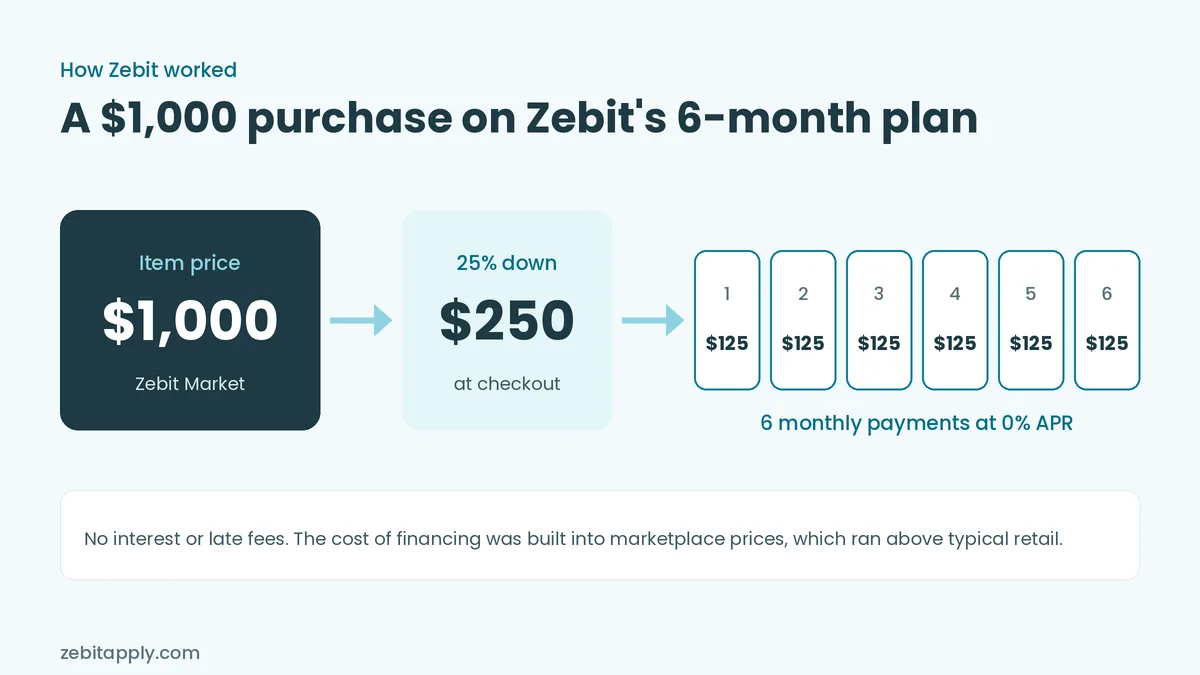
At checkout, members paid a down payment of about 25 percent on your payment card. The remaining 75 percent of the purchase price was then split into equal monthly installments.
Representative example from Zebit's own disclosures: a $1,000 item required a $250 down payment at checkout, with $750 financed at 0 percent APR for six months. That worked out to $125 per month for six months on the financed portion. The company held your card on file to collect each installment automatically.
Step 5: The six-month payment plan
The standard payment schedule was six months. The company recommended auto-pay so installments ran automatically on the due date. There was no interest and no late fee if you missed a payment, but the company could freeze or reduce your spending limit after a missed payment and could restrict future purchases until the account caught up.
When a payment plan completed in full, your spending limit refreshed and you could place a new order using the full approved amount.
How Zebit made money without charging interest
Revenue came from the markup between wholesale cost and marketplace retail price. If the company sourced a product for $750 and sold it in the Zebit Market for $1,000, the $250 gross margin funded the six-month BNPL plan. From Zebit's own CFO interviews: the company captured the full retail gross margin on each marketplace sale.
That is also why shoppers often reported that marketplace prices ran above typical e-commerce listings. The markup was effectively the price of the financing, baked into the sticker. Our Zebit payment calculator breaks down what that markup actually cost on representative purchase sizes.
Returns, warranties, and customer service
Zebit accepted returns within a limited window and required the shopper to report problems within ten days of receiving a damaged or defective product. Because fulfillment ran through drop-ship partners, actual return handling and refunds could take longer than at a vertically integrated retailer.
Trustpilot and other consumer review platforms carried a mix of positive accounts, especially from long-term customers who used Zebit as a reliable path to credit when they had no other option, alongside recurring complaints about pricing, shipping fees, and customer-service response times.
How Zebit differed from Affirm, Klarna, and Afterpay
Affirm, Klarna, Afterpay, PayPal Pay in 4, and Zip all plug into third-party merchants. You shop at Target or Nike and choose one of them at checkout to split the payment. Zebit was both the store and the lender. You could only use your credit inside the Zebit Market, and the company owned the full relationship from product listing to final payment.
That gave it a tighter grip on underwriting but also narrowed the shopping experience. For a 1-for-1 lease-to-own equivalent today, Katapult, Snap Finance, and Progressive Leasing are the closest replacements. See the Zebit alternatives page for a full comparison.